Although there were many events that led to the eventual
founding of the German nation in 1871, arguable the most influential were set
in motion by Otto von Bismarck. Although his intent was to establish Prussian
hegemony in Germany (pg 138), he ended up creating the perfect blend of
political and social sentiments to create a united Germany.
 |
| Otto von Bismarck (1815-1898) |
To start, the genius of this man politically has to be
recognized. He realized early on that his goal would only happen insofar as the
other great European powers would consent to goals (pg 139). In order for them
to consent, they would have to be focused on other matters that drew their
attention away from any sort of unification within the German state. When
Denmark annexed Schleswig in November 1863 (pg 139) it provided the perfect
backdrop for Bismarck to plan an invasion of the country. He faced a challenge
in that the liberal nationalists opposed his policies (pg 139). However, their
opposition provided a screen for him to operate behind. By allying Prussia with
Austria and acting in concert, he was able to incorporate the liberated duchies
as an “Austro-Prussian condominium” (pg 140). This obviously enraged the
liberals, who wanted the new territory to be incorporated as part of the German
Confederation.
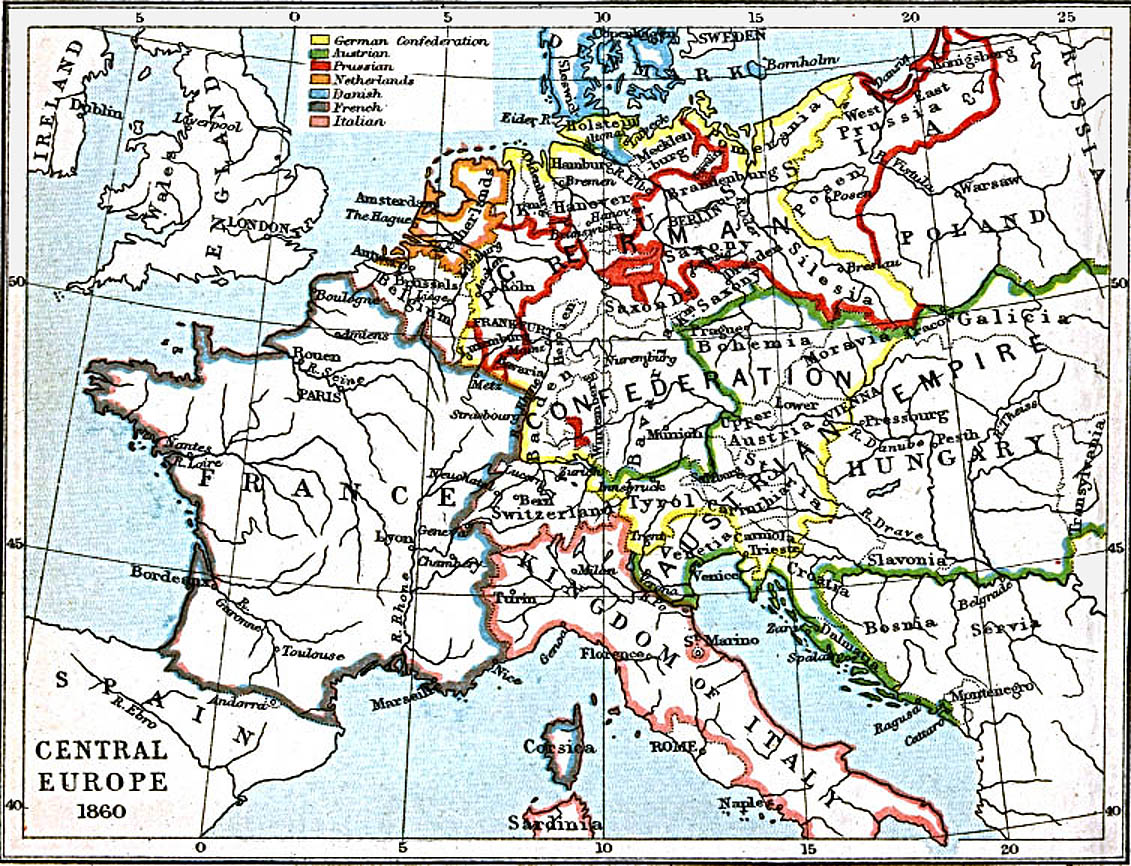 |
| Central Europe in the 1860s |
This move added to the German identity in that it was a
ruthless and efficient way of dealing with a matter, something that German’s
are stereotyped for even today. As Bismarck himself stated; “The great
questions of the age are not settled with speeches and majority votes…but by
iron and blood” (pg 140). While his principles may not have been altogether
ethic, no one could dispute that they were effective in achieving the desired
outcome. Ultimately, Bismarck was able to prove that the liberal movement was
vocal but had no real power.
The next step in his plan to expand Prussian power would
allow him to realize his goal of a lasting hegemony in Germany and a final reckoning
with Austria (pg 140). The two powers had a very slim balance, and usually they
had the buffer of the rest of the German speaking lands between them to prevent
any conflict. But the war with the Danish had created a change; it was the
first time that the lines of central Europe had been redrawn without
intervention from any external powers (pg 141). This also created an
opportunity to shape the identity of the German state because for the first
time in a long time there was a window of opportunity for a strong nation state
to seize power and shape central Europe in a way that had not been seen before
(pg 141).
 |
| Austro-Prussian War 1866 |
A challenge to Bismarck’s plans would obviously be Austria,
but after the battle of Koninggratz in 1866 Austria was no longer a threat. The
battle represented a critical stage in the unity of Germany in that had Austria
won the German Confederation would have dismantled Bismarck’s plans for
Prussian supremacy (pg 142). When the Treaty of Prague was signed, it allowed
Prussia to be the main seat of power in the north of Germany. This shaped the
German identity because the smaller northern states in Germany would now be
under the jurisdiction of Prussia and all of its propaganda. This propaganda
would have a profound influence on the thoughts and feelings of those living in
the north.
 |
| The Battle of Koninggratz |
With the crowning of King William I of Prussia as the German
Emperor in 1871, the unity of Germany was complete, and Bismarck had effectively
achieved his goals. His actions helped to literally shape the German state.
Because of him, all German people now had a central government that they could
affiliate with, creating a sense of nationality that had not existed in the
past (pg 145). This was essential in creating an identity for the German
people. Before, as a conglomerate of territories, there had been no central
power to stand behind. But now the German people had a seat of power that they
could all stand behind.
 |
| King William I Emperor of Germany |

No comments:
Post a Comment