 |
| Post-war inflation was so bad that burning money was more cost effective than buying coal to heat a furnace. |
World
War one was a defeat for Germany that reached into many elements of the German
identity. The most obvious losses were those that were tangible; people, land,
and resources. The Treaty of Versailles took 20% of the land, 10% of the
people, and 80% of the iron ore reserves that the Germans mined for their livelihood
(203). Without these resources, the already weakened country could not defend
itself and could not recover easily from the war. To add insult to injury, the
Treaty was signed in the same place where the founding of the German Empire had
occurred not fifty years earlier (204). The losers had to not only deal with the
tough terms of the Treaty but the vicious irony of the victors as well. This
led to a lot of enmity towards the Treaty. Even though the German’s opposed the
conditions, they were in no place to negotiate for different terms. The people were
humiliated by the “dictat”. To them, it was an instance of the West proving its
might and rubbing in the defeat of the German army. This affected the view of
the West that Germans had. The West was cruel and vengeful, something the
Germans would remember come World War two.
 |
| The terms of the Treaty were harsh, and would be hard for the German people to swallow. |
The Treaty made a mark on the
German people in that it took away from a people that were already exhausted
from a lengthy and bloody war. The prevailing sentiment among the Germans was
that unjust terms were being thrust on a defenseless country (204). This would
come into play later with the rise of the Nazi party. The German people were desperate
for change, hope, and a sense of community. All of those wants were addressed
by Hitler. He was a man that the people could look to and see power. He lit the
fires in people’s hearts and gave them hope. His listeners were people in
despair, feeling victimized and haunted by inner demons, starved for good news
and stimulation, and indifferent to rational programs and logical arguments.
The Fuher demanded from them faith and devotion, promising in return certainty
and the security of a new, protective and apparently meaningful community; this
was what people sought and found in Hitler and his message (233). Hitler
changed the views of the German people; before, they deal with the Depression,
harsh reparations, and a collapse of their political system. Now, with Hitler
in charge, they sensed that a turning point was near.
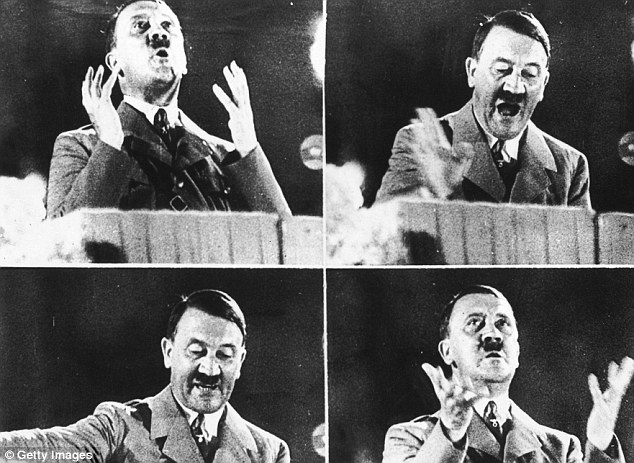 |
| Hitler was a very animated speaker; he played to his audiences emotions to win them over. |
When I first learned about the
Nazis, I always wondered how the party was able to gain so much traction with
the people. I never got as much back story before. After seeing the state that
the Germans came out of right before World War two, I can see how the Treaty
and the rest of the world changed their view of themselves. Before World War
one, the German people had been very successful in their military endeavors. They
had a successful economy and were able to enjoy a lot of privileges. After the
war, those all got taken away. It changed their identity; before a proud and somewhat
arrogant people, now a humbled yet resentful population. Hitler gave this
population the promise of freedom from other nations, the ability to restore
Germany to its former glory. If I was a member of the population at this time,
I certainly would find it hard to resist Hitler’s ideals. The promise of better
times and a restored nation would have been something that was finally good
enough to rally around. This changed the people in that it gave them hope for something
better since the end of World War one. That
would certainly be something hard to resist, hence why Hitler was able
to become so powerful.
 |
| Hitler made displays of power to show the people that they were strong and could rise from the ashes of WWI |
