Martin Luther was truly one of the most important men of his time. His thoughts and words brought about a cultural, political, and religious revolution the likes of which had never been seen before. He was an example of how people should act when faced with corruption within a social structure. Instead of standing by and accepting the problem as a part of life, he openly opposed the corruption within the church and stood his ground no matter the outcome. Even being faced with interrogation and excommunication, Martin Luther stuck to his morals and never renounced his beliefs. He set an example to Germans by showing that if you truly believe in something you shouldn't have to change your mind because someone or something more powerful doesn't like what you are doing. This helped him to achieve his goal of changing the church, even though it was not quite in the manner he intended.
 |
| Martin Luther displaying his 95 theses |
Even though Luther's main goal was a revision of the church, he still managed to affect the political structure of Germany. His treatise capitalized on the growing resentment of the secular world towards the church. He was able to use the psyche of the population to his advantage, appealing to the rulers of the German lands to rise up together and remove the corruption from the church. By focusing on the amount of money that the church was taking from the people and the principalities, it allowed the leaders to say that they were ready for church reform because a more altruistic set of ideals, not simply that they were greedy men and that they wanted more money for themselves. Combined with the fact that the secular rulers were not very fond of the clergy, this helped to keep him alive and not being arrested for heresy. Because of his ideas that the connection between a person and God does not need to involve the church, he also made it easier for the secular rulers to distance themselves even further from the pope and the rules of the church. This widening between the secular and the divine created a power gap that put kings and princes ahead of the church for the first time.
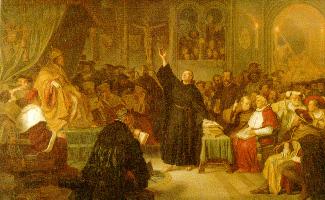 |
| Martin Luther at the Diet of Worms |
Luther's teachings gave power to the ordinary man. In a time were most of the power was with the nobles and the hierarchy within the church, this was outstanding. By giving the common man the power to interact with God on his own time, Luther empowered the lower classes to new levels. By using pictures in his writings, he was able to spread his knowledge to a wider swathe of people. By using the printing press he was able to disseminate his information quickly and with clarity. By being the first propagandist, he was able to bolster the strength of his argument with a diverse amount of people. From his time forward, all advertising of ideas moved toward propaganda, with a special emphasis on war. Had he not used the printing press to move his ideas, who knows if it would have been used in a similar manner by anyone else. This mass dissemination of information allowed the majority of the population, not just the powerful, to be aware of current happenings. This gave the large working class an advantage they were not used to having before. Not only did they have access to new information, but Luther also gave them the ability to deal with God on a personal level.
 |
| Martin Luther used the printing press to disseminate his ideas to the masses |
Martin Luther revolutionized the way Christians interacted with God. Before him, the church and the clergy acted as middle men between the general populace and God. With Luther's teaching however the middle men were removed, and the population could talk to God themselves. This left the clergy almost obsolete. Combined with their material extravagance, they were easy targets for serfs who had little to no material wealth and therefore did not have much to lose in conflict. Even though Luther did not intend for his theses to cause such a revolution, I think that just makes him more respectable. Here is a man who just wanted people to open their eyes to the corruption within the church, not rebel against it and democratize it. Yet his ideas and words were so powerful that it helped to change the way in which people fundamentally interacted with their deity.
726 words

