 |
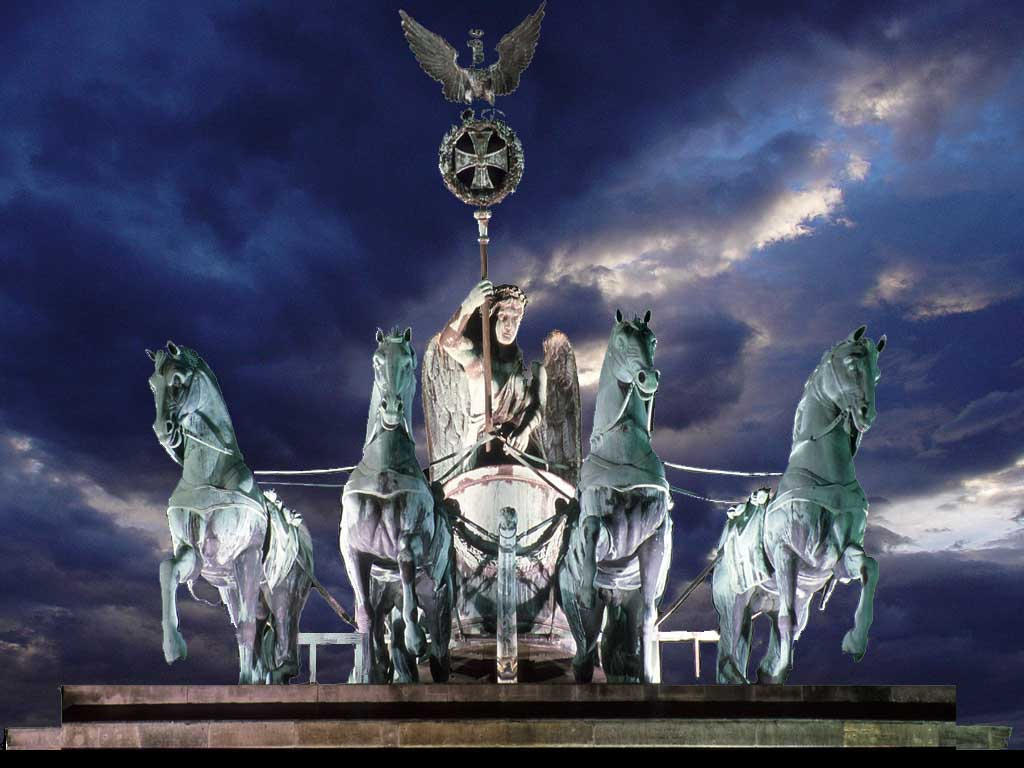
| The quadriga atop the Brandenburg Gate |
Frederick the Great is a name that appears frequently throughout the history of Berlin. From his childhood in the city to his inspiring quadriga atop the Brandenburg gate, Frederick made his mark on the ages old city. When I was watching the Berlin documentary, I couldn't help but compare this man to America's own celebrated military hero and first president George Washington. Before the Nazi regime, he was called a hero and a warrior, helping to shape the future of the German nation. In many ways, Washington is a respected hero of the American people, and even though his military achievements were not as great he is still considered a successful military leader. Washington has the advantage of not having a tarnished reputation due to history, but one can wonder if the same fate might befall his memory if America were to ever lose the image of its history.
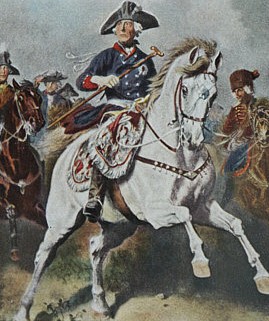 |
| Frederick the Great |
I found it most interesting that the image of Frederick has been so prevalent throughout the history of the city of Berlin. The story about the painting of him that Hitler had in his bunker just shows how important he was to the German people. I also found it interesting how he went from being, to the German people, one of the greatest monarchs of all time to a wicked man with a bad heart. It is interesting to see how a person can change based on the opinions of the people. How will American's view George Bush and Barrack Obama centuries from now? As the seriousness of the moment fades with the times, and historians are better able to analyze presidential contributions, will Bush seem as stupid as he did when he was in office? Will we still blame Obama for unemployment and high gas prices? Only time will tell I suppose.
 |
| How will the image of recent presidents change over time? |
Before watching the documentary, I had been familiar with the division between East and West Berlin, but I did not know much about it. I knew that West Berlin was the side that represented the free world, and the East side communist ideals. However, much of what I know about the division between the East and West focused most on Western Berlin. I had no idea that the East side attracted people from North Vietnam. It makes sense though, considering they also had a communist idea set. After hearing about how East Germans felt threatened by their jobs being taken by the Vietnamese, I couldn't help but think about Americans and the fears of our job markets being exported overseas, and threatened here at home by other groups.As someone who has not been outside of the country, I find it easy sometimes to fall into the fallacy that all problems in America are unique to America alone. Learning about the struggle of the Vietnamese in East Berlin reminded me that some problems are universal.
 |
| Vietnamese workers were seen as undesirable after the fall of the wall. |
Before I saw this documentary, I had never thought about the psychological implications of the wall. I was struck by how cruel the wall was to friends and family alike. Cutting families apart and separating people would be hard to deal with emotionally. How did the ideals that separated East and West Berlin affect families that were separated? Did different parts of families change with their sides, or did they stay true to their familiar values? Hypothetically speaking, if two brothers were separated, one in the East and one in the West, and made no contact with each other while the wall was up, would they still have similar values? The psychological implications of the wall are many, it would be interesting to see if there were any studies done on families separated by it.
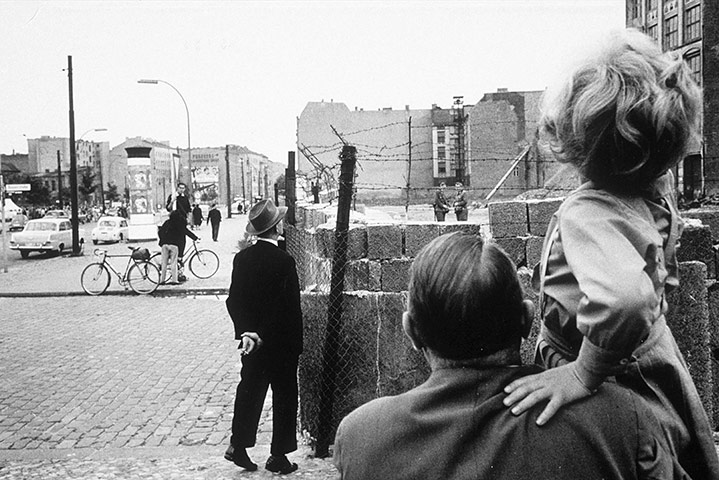 |
| How did the separation of families impact the psyche of people in Berlin? |
Word Count: 610

No comments:
Post a Comment